This past Saturday, I lucked into a spot as a non-food vendor at the Hingham Farmer’s Market and had my first fair-selling experience. It was a lot of work, but definitely worth the effort for an opportunity to get off the internet and share my art with the good people of Hingham.
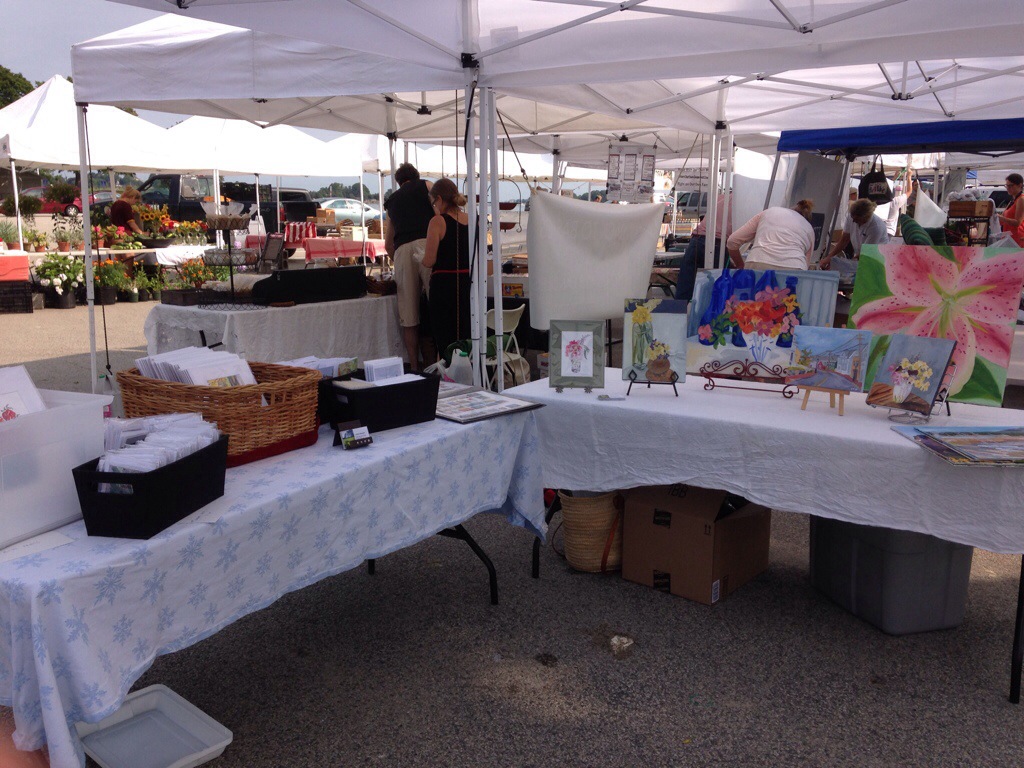
My booth at the Hingham Farmer’s Market
I applied to the market when I moved back to Boston, but because it’s quite a popular one I was already too late to get a regular spot. I found out a couple of weeks ago that someone had cancelled their reserved spot at this week’s market, and instantly grabbed the opportunity. As I prepared for the market, I kept wanting to blog about the process. Then suddenly I was pulling all-nighters just to get everything done in time, and the blog post was put on the “later” list.
Before I go any further, I just want to thank everyone who stopped by and admired my work–even if you didn’t buy anything, your comments meant a lot to me. I also want to thank everyone who helped me: Madison, for assisting with decisions and lending moral support as I stayed up all night; my mother for helping with assembly and logistics, and for keeping me company at the market; my father for cleaning up when I had to rush to another obligation; and Sarah and Reinhold for lending me tables and helping set up and clean up. I really could not have pulled this off without all of them.
Obligatory–but sincere–acknowledgements out of the way, I’m eager to share about the experience of preparing for and attending the market.
First, the preparation. I immediately realized that I would need a stock of ‘low cost’ items – ie., prints and cards, since most people don’t attend Farmer’s Markets with the intention of spending hundreds of dollars on an original painting. In the past, I have used a normal inkjet printer to print on cardstock for my greeting cards. This is a functional yet labor-intensive way to produce cards because I have to hand cut and score (fold) each one. I actually find menial physical tasks comforting when done in moderation, and was happy to reboot the one-woman card-making machine I had going during the holiday season. However, the printer decided it no longer liked its role in the greeting card production line, and stopped accepting cardstock. Meanwhile, I had no method for producing high-quality archival prints. I spent a couple of days doing extensive research on the most reputable and cost-effective printing options for both cards and prints, scouring online forums and compiling a massive spreadsheet of unit costs and pros-and-cons. Suddenly, looking at the costs, my spreadsheet morphed into a very detailed justification for buying a printer. I had already done research on printers a few months ago; a price drop and a generous rebate offer convinced me to go with my top choice, the Epson Stylus Pro R3000.
The decision was initially a cost-motivated investment, but my relationship with this printer has quickly become one of admiration and appreciation. The quality of cards and prints this machine turns out cannot even compare with the cards I was printing before. The prints are as good or better than any I could get at a professional print shop, but having this printer sprawled across half my coffee table means that I can print whenever and whatever I want. I have the power.
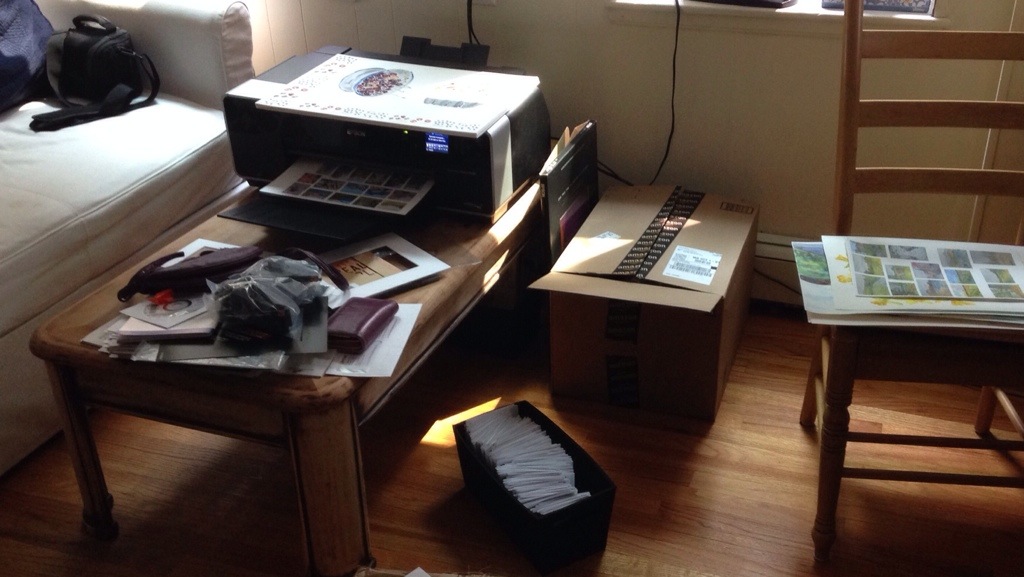
Our living room as a print shop.
Unfortunately, the short timespan and shipping delays meant that “whenever” turned out to be two nights before the Market–not exactly when I wanted. I spent an entire night printing, then the next day and a good portion of the night buying last-minute supplies (envelopes, etc.) and cutting and matting my prints. I knew I had too much merchandise, but it’s always good to be prepared.
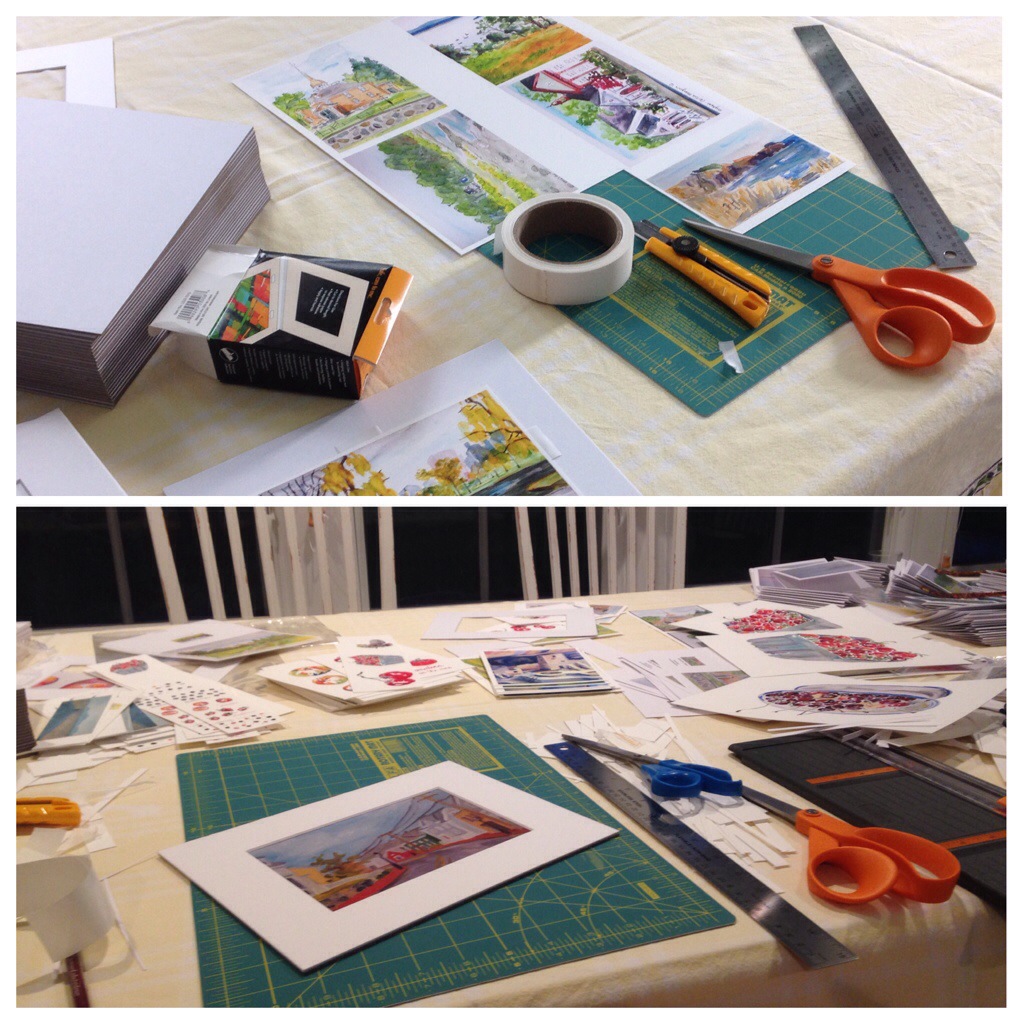
Above, my neat and organized setup at the beginning of the night; below, the cutting and matting station by the end of the night.
On the morning of the market, my exhaustion was (temporarily) erased by a shower, a cup of coffee, and the excitement of the day, and I was soon set up and ready for people to arrive. Unfortunately, the wind rendered my initial setup impractical, and the originals ended up flat on the table. Someday I will figure out a good hanging system, but for a first show I was happy with my setup (see photo, at top).
I spent much of the day chatting and sketching, and debating where to draw the line between the two. By personality, I am inclined to sit back and let people browse at their leisure without bothering them. But then, the advantage of selling your art personally at a fair is the opportunity to self-promote. I think it will take me a while to find an appropriate balance.
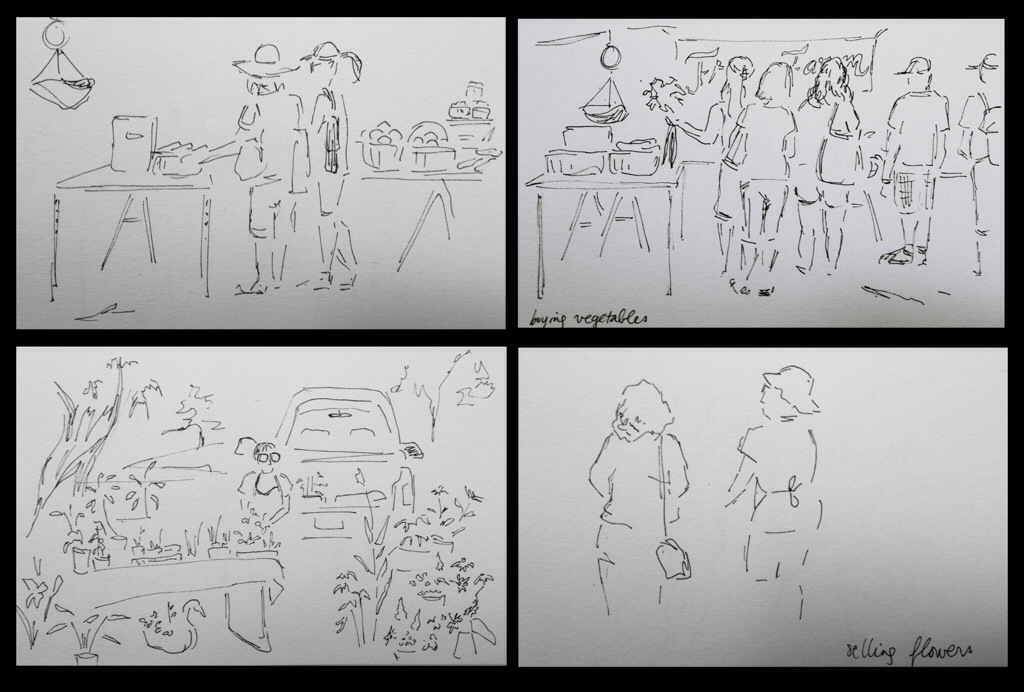
Views of the market.
Armed now with a surplus of prints and cards, and a sleek new printer ready to make even more, I am eager to find new markets and repeat the experience. I would especially like to find opportunities to sell at dedicated art fairs. Suggestions welcome!


